Showing posts with label health. Show all posts

Tuesday, October 31, 2017

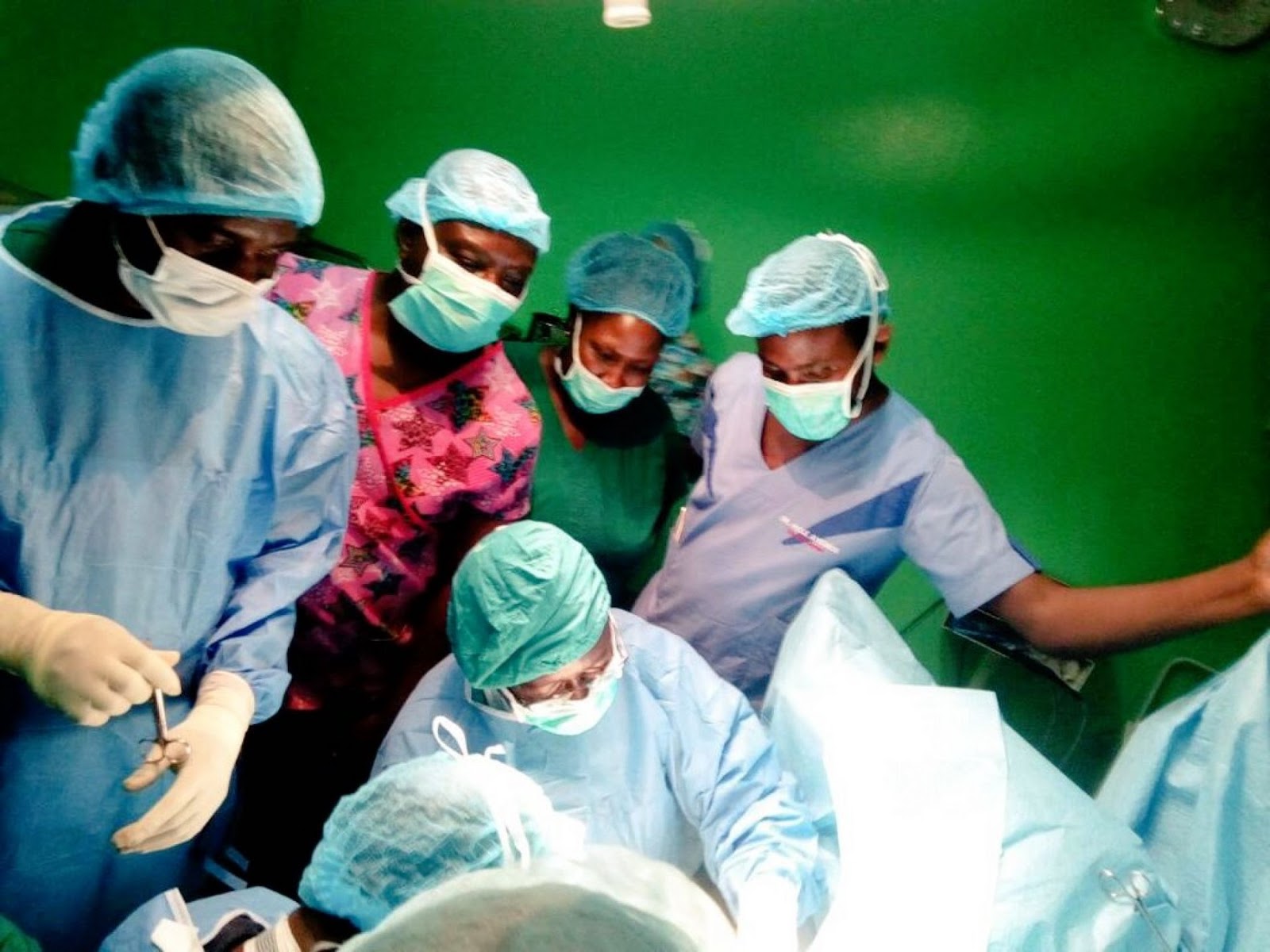
Federal Health Minister Lends a Hand to USAID Fistula Surgical Repair Clinic at Osun State Medical Center

Nigerian Minister of Health Professor Isaac Adewole performs fistula
surgery on a 37-year-old mother of four, alleviating four years
of continual suffering. The Minister assisted with a USAID-supported
free clinic in Osun State to highlight a nationwide initiative to
shrink Nigeria’s large backlog of cases awaiting treatment.
Minister of Health Professor Isaac Adewole took the Health Ministry’s efforts to rid Nigeria of untreated obstetric fistula into his own hands by “scrubbing in” at a free surgical repair clinic for fistula patients at an Osun State hospital in late July.

The Minister led a team of Nigeria’s top obstetric surgeons at the United States Agency for International Development (USAID)-supported event, which marked the commencement of a joint initiative between USAID and Osun State government to expand access to fistula repair treatments within the state. The initiative is part of a nationwide push to improve public access to health care services.

Tuesday, April 25, 2017

A Champion for Cancer Care in Nigeria

A champion of cancer research and better patient care, Runcie Chidebe has demonstrated to his native Nigeria the importance of volunteerism and collective action for causes that benefit society.  Through his nonprofit, Project PINK BLUE - Health and Psychological Trust Centre, he’s changing the narrative about cancer in Nigeria and engaging government, nonprofit, and private sector partners to work toward greater support for cancer patients.

Since returning from his 2016 inspiring “Youth and Civic Participation” International Visitor Leadership Program (IVLP) exchange, Runcie has explored leadership strategies that facilitate social empowerment and justice, particularly for underserved communities.  He has engaged more than 300 volunteers in series of cancer awareness programs, founded a cancer patient support hotline, and organized large-scale events in Africa’s largest city, Lagos, and Nigeria’s capital, Abuja.  At a May 2016 Democracy Day event co-hosted by U.S. Embassy Abuja, he presented a paper entitled “Civic participation: stimulating empathy in Nigerian youths,” in which he encouraged youth to become civic leaders and build connections in their community through citizen engagement.  In January 2017, he and Abuja alumni partners organized an impressive program with 300 secondary students to celebrate the life and values of Martin Luther King, Jr.  The program included student speeches, mentoring discussions by U.S. exchange program alumni, participation by U.S. Embassy staff, and a screening of the film Selma.  As an active member of the Abuja Alumni Chapter, Runcie frequently uses his connections with the U.S. Embassy to organize events at U.S. Mission Nigeria’s network of 11 American corners.   He seizes every opportunity to educate, inspire, and empower Nigerian youth.

Tuesday, March 11, 2014

SHUGA-SHUGA


Photo: aids.gov
When I first heard the word “SHUGA” from a colleague I thought she was referring to the normal sugar.  Turns out it’s the title of a drama that provides great entertainment but important messages about HIV/AIDS and other health issues.

The production of SHUGA 3, the third production in the MTV award winning TV series – “SHUGA” – took place in Lagos and included mostly upcoming Nigerian actors and actresses.  More than three years ago the first production of SHUGA (“SHUGA 1”) was filmed in Kenya to highlight the risks young Kenyans faced when being sexually active without the use of protection and living careless lifestyles.  SHUGA 3 highlights the realities for youth in Nigeria.

Thursday, May 17, 2012

Prevention is Better than Cure

This posting's title is a popular adage in Nigeria mainly used in relation to health issues.  It serves to show the importance of taking measures to prevent illness rather than go through the trouble of treatment.  A very good example of this is getting vaccinated to prevent infection by certain diseases.  Today many diseases that hitherto resulted in death or disability have been brought under control as a result of immunization.  Diseases like smallpox, whooping cough, measles and polio.
First documented vaccines began when a British doctor Edward Jenner noticed milkmaids who had cowpox never contracted small pox.  He then carried out an experiment in 1796 in which puss from a cowpox blister was inserted into an eight year old boy and proved that having been inoculated with cowpox the boy was immune to smallpox.  From this beginning vaccines have been developed to protect against many fatal or serious diseases.  Better yet, smallpox has been eradicated thanks to the pioneering work of Edward Jenner.
Today immunization starts at birth and most are usually completed by the time the child is two years old.  Why start so early?  Why not wait until the child is grown?  This is what the U.S. Centers for Disease Control and Prevention (CDC) has to say.